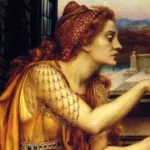
International Women’s Day edition: for anyone who prefers their feminist icons with a crown, a scandal, or a very suspicious bottle of water.
Why talk about “dark history” on International Women’s Day?
Rome is usually presented as a parade of men in marble: emperors, generals, popes. But look closer, and you find something else: powerful women in Roman history operating in courts, palaces, alleys and apothecaries, bending the city’s fate to their will.
Some were accused of poisoning. Some rewired the Church. Some refused to endure abuse quietly. All of them were later branded dangerous, scandalous, “too much”.
This isn’t a list of female villains. It’s a roll call of women who refused to stay where Roman society put them, and left scorch marks on the city in the process.
And yes, you can still walk the streets where they loved, plotted, ruled and, occasionally, haunted. Welcome to the dark history of Rome, told through the women who shaped it, and the Rome ghost tour that brings their stories back to life.
1. Livia Drusilla – The Empress Who May Have Poisoned an Empire
Start with the woman who practically invented the role of “First Lady of Rome”.
Livia Drusilla married Octavian, the future Emperor Augustus, in 38 BC while she was pregnant by another man. He divorced his wife, took Livia instead, and later adopted her son. Romance, Roman style.
For the next five decades, Livia was his closest adviser. She received ambassadors, weighed in on policy and succession, and ran an imperial household that was basically a political nerve centre. In a legal system that treated women as dependents, she operated like a head of state in everything but the job title.
The rumoured body count
Ancient gossip credits Livia with an impressive list of “convenient” deaths:
- Marcellus, Augustus’s nephew and early heir, died young in a plague year.
- Gaius and Lucius Caesar, his grandsons and adopted heirs, both died in their twenties.
- Agrippa Postumus, the last spare heir, was killed as soon as Augustus died.
- Then there’s Augustus himself, supposedly finished off by Livia with a batch of poisoned figs from his favourite tree.
Do we know she did it? No. Do the rumours tell us how uncomfortable Rome was with a woman who seemed to always benefit from a reshuffled succession? Very much yes.
Modern historians lean more towards “political lightning rod” than “super-poisoner”. Augustus was old and ill. Disease was everywhere. But in a city that loved conspiracy, blaming Livia was more satisfying than admitting chaos.
Where to find her in Rome
Theatre of Marcellus — a monument to the first lost heir. On our Ancient Rome’s Dark Side tour, we talk about how easily grief turns into suspicion when inheritance is involved.
Palatine Hill — the hill of emperors and their families, where Livia’s home once overlooked the Forum and the city she quietly helped run.
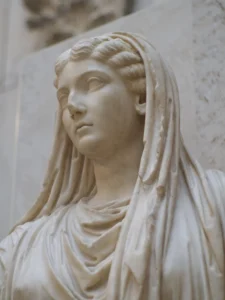
Rowanwindwhistler, CC BY-SA 4.0 https://creativecommons.org/licenses/by-sa/4.0, via Wikimedia Commons
2. Agrippina the Younger – The Woman Who Made an Emperor
Agrippina the Younger collected imperial titles the way some people collect magnets.
Granddaughter of Augustus. Sister of Caligula. Wife of Emperor Claudius. Mother of Emperor Nero. Her family dinners were probably tense.
Exiled under her brother Caligula, she came back from political oblivion and immediately started rebuilding her position. A rich second marriage put money and connections in her hands. Then she aimed higher.
The uncle, the marriage, and the mushrooms
In 49 AD, Agrippina married her uncle, Emperor Claudius. Romans winced. Agrippina smiled and got to work.
She persuaded Claudius to:
- adopt her son Nero,
- Marry him to Claudius’ daughter Octavia,
- and slowly sideline his own son, Britannicus.
When Claudius died in 54 AD after eating a plate of mushrooms, everyone looked at Agrippina. Ancient writers label them “the mushrooms of the gods” and strongly imply poison. Maybe. Or maybe he died like many older Romans: from age and bad medical luck.
Either way, Nero became emperor at sixteen. That was Agrippina’s doing.
Co-ruling with her son… briefly
For a few years, Agrippina stood almost shoulder-to-shoulder with Nero:
- Coins showed their faces together.
- Ambassadors were brought to her.
- She sat with the emperor at public events.
Then Nero hit late adolescence and decided he would prefer to be absolute ruler without the woman who had built his throne.
Cue murder attempt number one: the famous collapsing-boat plan at Baiae. The deck was rigged to fall away and drown her. It malfunctioned. Agrippina swam ashore in the dark and made it back to her villa, furious and very much alive.
Murder attempt number two was simpler. Nero sent soldiers. According to legend, Agrippina bared her midriff and told them to strike the womb that had borne him. They obliged.
Where she still watches
From the ruins on the Palatine Hill, you can look down over the Forum and imagine Agrippina in the palaces now reduced to brick and grass. On our Ancient Rome ghost tour, we talk about her as what she was: a woman who created an emperor and was killed for her trouble.
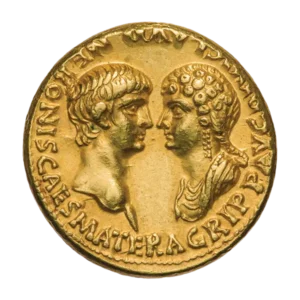
Agrippina was the first woman to be shown as an Emperor’s equal partner, with her son, Nero
АНО “Международный нумизматический клуб”, CC BY-SA 4.0 https://creativecommons.org/licenses/by-sa/4.0, via Wikimedia Commons
3. Messalina – Rome’s “Scandalous Empress” Reconsidered
Messalina is what happens when a clever, well-connected young woman becomes the official scapegoat for everything wrong with an emperor’s reign.
Married to Claudius in her teens, she quickly gained real influence:
- She interfered in trials,
- pushed for executions,
- and shaped who rose and who fell in the Senate.
If she had been a man, Rome would have called it “strong leadership”. Instead, later writers turned her into a cautionary sex nightmare.
Brothels, wigs and a 24-hour contest
Decades after her death, male authors went to town:
- Juvenal claims Messalina snuck out at night in a blonde wig to work in a Subura brothel under the name “Lycisca” (She-Wolf).
- Pliny insists she entered a 24-hour endurance contest with Rome’s most famous prostitute and won with twenty-five clients.
- Tacitus treats these stories with a straight face, because of course he does.
Modern historians, looking at the sources without a toga and a grudge, see propaganda: a powerful empress retroactively smeared as sexually insatiable to justify her downfall. It’s easier to condemn a woman’s body than admit you were scared of her mind.
The “wedding” that cost her everything
Messalina’s real mistake was political, not sexual.
In 48 AD, while Claudius was away, she publicly married her lover Gaius Silius in a full ceremony. He divorced his wife first. Friends attended. It looked less like an affair, more like a coup.
Was she planning to replace Claudius with Silius as emperor, keeping herself on the throne beside him? That’s what her enemies claimed, and in Roman politics, perception was the verdict.
Claudius hurried back, listened to his advisers and ordered executions. Messalina fled to the Gardens of Lucullus. When the time came, she couldn’t bring herself to use the sword. A soldier finished the job.
Denied burial rites, she became exactly what Rome likes to create: a restless shade in its own imagination.
Where her legend sleeps (and doesn’t)
The old Subura district, now Monti, is where the brothel stories place Messalina at night in her blonde wig. On Ancient Rome’s Dark Side, we end in these streets, talking about a woman whose worst crime was behaving like the men around her – and being judged by different rules.
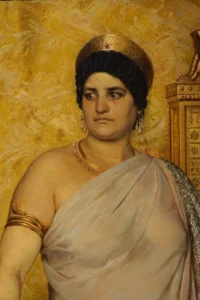
Peder Severin Krøyer, CC BY-SA 3.0 https://creativecommons.org/licenses/by-sa/3.0, via Wikimedia Commons
4. Marozia – The Woman Who Controlled the Papacy
Now to medieval Rome, when the city was smaller, dirtier, and politics ran through families rather than institutions.
Marozia was born into the powerful Tusculan clan, daughter of Theophylact and Theodora, who essentially governed Rome while popes came and went. As a teenager, she was given to Pope Sergius III as his lover. It was less romance, more succession planning.
She learned fast and played long.
Building a papal family business
Over the next decades, via marriages, alliances and sharper instincts than most of her male rivals, Marozia managed to:
- place lovers and allies on the papal throne,
- help imprison Pope John X in Castel Sant’Angelo, where he died,
- and eventually see her own son become Pope John XI.
Later chroniclers, horrified by this much female influence, called the era the Pornocracy – “rule of the harlots”. It tells you a lot about their vocabulary, and nothing at all about her competence.
The wedding that became an overthrow
In 932, Marozia married King Hugh of Italy at Castel Sant’Angelo. It was meant to seal her power. Instead, it ended it.
During the celebrations, her son Alberic II led a revolt. Hugh escaped down the castle walls on a rope. Marozia was captured and imprisoned in the same fortress where she’d once kept popes in line. She died there, caged inside the system she had manipulated for years.
Where her story still echoes
Castel Sant’Angelo is now a postcard view with a café. It was once Marozia’s stronghold and her prison. On our Rome Ghost Tour, you can stand on Ponte Sant’Angelo, look up at the bastions and think about a woman who controlled the papacy so effectively that history had to insult her to cope.
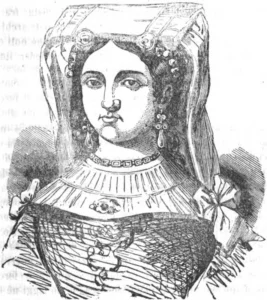
Franco Mistrali, Public domain, from Wikimedia Commons
5. Olimpia Maidalchini – The “Female Pope” of Baroque Rome
Shift to the seventeenth century. Baroque Rome: glittering altars, powdered wigs, sins with better lighting.
Olimpia Maidalchini was born into a minor noble family near Viterbo. Her father refused to pay a proper dowry, which narrowed her options to convent or creativity. She chose creativity.
She married a rich man without permission, became a widow with money two years later, and moved to Rome.
From brothels to the Blessed
In Rome, Olimpia invested in property on Via delle Zoccolette – “Street of the Little Prostitutes” – running brothels and, with impressive moral multitasking, founding an orphanage and a retirement home for ageing sex workers.
Clergy were regular visitors to her establishments. Information flowed in both directions.
Her second marriage into the Pamphilj family plugged her into a higher voltage of power. Her brother-in-law, Giovanni Battista Pamphilj, wanted the papacy. Olimpia helped with the fundraising and influence. In 1644, he became Pope Innocent X.
La Papessa of Piazza Navona
Once Innocent X was on the throne, Olimpia settled into the Pamphilj palace on Piazza Navona and effectively ran the operation:
- She managed access to the Pope,
- oversaw appointments and finances,
- and accepted “gifts” that helped nudge decisions in the right direction.
Rome gave her two nicknames:
- La Papessa — the Female Pope.
- La Pimpaccia — the sinful madam.
Both were true, depending on who was paying you.
The night she left with the silver
When Innocent X lay dying of plague in 1655, Olimpia understood what came next: a conclave, a new pope, and no more need for her.
So she moved first.
Accounts describe her stripping the papal apartments of valuables, loading them into a black carriage and heading for Viterbo. She allegedly refused to pay for the Pope’s funeral, remarking that a man who had held such a rich office should have saved enough for his own burial.
She died of plague a few years later, comfortably out of reach.
Legend says her ghost still races across Ponte Sisto in a demonic carriage before dawn, chased by howling shapes and late-night drinkers.
Where to follow her
On our Rome Ghost Tour, we walk across Ponte Sisto and through Piazza Navona, using Olimpia as a reminder that the Church’s moral outrage has always been surprisingly selective.
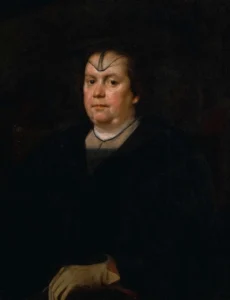
Olimpia Maidalchini – Public Domain
6. Giulia Tofana – Poison as an Exit Strategy
And now, a correction — and a rare dark story where the original mastermind actually wins.
Contrary to many popular stories about her, Giulia Tofana did not end her life on a scaffold. She ran a lethal little business for years, retired, and died peacefully in her bed in 1651. No trial. No confession. No dramatic last words. Just a quiet death for a woman who had helped more husbands to the grave than most plagues.
The apothecary with interesting stock
Giulia ran an apothecary in Rome. On the surface, she sold:
- cosmetics for the complexion,
- herbal remedies,
- devotional “waters” that looked pious on a shelf.
One bottle, however, contained something else: Acqua Tofana.
It was:
- clear and nearly tasteless,
- easily mixed into soup, wine or broth,
- and designed to work slowly, over several doses.
A few drops a day, and a husband would fall ill in a way that looked very normal for the seventeenth century: stomach pains, weakness, wasting away. Wives were advised to nurse him tenderly, consult doctors and pray. It helped the performance.
To everyone else, he died of natural causes. To his widow, he died of finally having an option.
Why so many women turned to her
In early modern Rome, women had almost no legal way out of marriage:
- Divorce was essentially reserved for the powerful.
- Separation meant scandal and poverty.
- A violent or miserable husband was considered unfortunate, not illegal.
Acqua Tofana was not just poison. It was an unofficial, underground divorce service with a very permanent clause.
Giulia’s clients were mostly ordinary women trapped in homes they couldn’t leave. Word of mouth spread quietly: there is a woman at such-and-such apothecary who can help.
And then, crucially, Giulia got out in time. She died in 1651, respected in her neighbourhood and never exposed.
When the daughter took it global
After Giulia’s death, her daughter inherited more than just the apothecary. She got:
- the formula for Acqua Tofana,
- the trusted contacts,
- and a proven business model.
Where Giulia had kept things relatively contained, her daughter thought bigger. The network expanded:
- more go-betweens in different districts,
- more women offering the “solution” quietly in markets and parishes,
- more husbands suddenly developing mysterious illnesses.
At that scale, discretion becomes harder. Eventually, something snapped: a client panicked, a husband survived long enough to talk, or a priest saw a pattern in his confessional.
Authorities finally followed the trail.
Giulia’s daughter and several women who worked for her were arrested, tortured and executed. The courts, which had never provided their clients with a legal escape, made an example of the ones who provided an illegal one.
Giulia, meanwhile, stayed exactly where she had placed herself: untouchable, and slightly smug from beyond the grave.
Where her ghost doesn’t live, but her story does
On Via dei Banchi Vecchi, a crooked old building looms above a modern gelato shop. Local tradition ties it to Giulia’s original apothecary. Today, you’re more likely to leave with pistachio on your shirt than poison in your veins.
We pause there on the Rome Ghost Tour and unpack the layers: the chemistry, the gossip, the women who saw Acqua Tofana not as wickedness, but as the only safety net they were ever offered.
If you want the forensic version, we’ve broken it down in detail here: Giulia Tofana and Acqua Tofana.
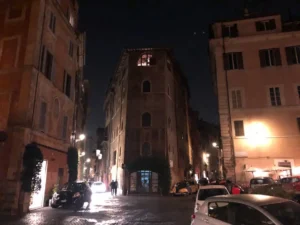
The building on Via dei Banchi Vecchi, from where Giulia – and later her daughter Girolama – ran the apothecary
7. Beatrice Cenci – The Girl Rome Turned Into a Ghost
Finally, the one Roman teenagers still whisper about.
Beatrice Cenci was born in 1577 into a rich, thoroughly cursed family. Her father, Francesco Cenci, was infamous for violence, corruption and the kind of domestic cruelty that even other nobles thought was a bit much.
He abused his first wife, brutalised his sons and, according to multiple accounts, repeatedly raped Beatrice. Fines were issued. Nothing really changed. Money and status did their usual work.
When his scandals became too public, the solution was not prison. It was geography. He locked Beatrice and his second wife, Lucrezia, away in a remote fortress at La Petrella in the Abruzzi. Beatrice tried to get help through official channels. Rome looked away.
Murder as a last resort
In 1598, Beatrice, Lucrezia, her brother Giacomo, and two servants (one of whom, Olimpio Calvetti, was supposedly Beatrice’s lover) plotted Francesco’s death.
The plan:
- drug him,
- bludgeon him with a hammer while he slept,
- push his body over the balcony to simulate an accident.
It might have worked if rumours and inconsistencies hadn’t drawn attention. The authorities investigated, found too many convenient details, and arrested the entire group.
Under torture, confessions followed. Rome, meanwhile, mostly sided with Beatrice. People knew what Francesco was. They hoped for mercy.
Justice, papal-style
Pope Clement VIII had other priorities. Executing the Cenci meant confiscating their estate for the Church. Forgiveness was not financially attractive.
On 11 September 1599, the executions took place near Ponte Sant’Angelo:
- Giacomo was tortured, then his skull crushed and his body quartered.
- Lucrezia and Beatrice, dressed in white, were beheaded.
The crowd was horrified. Whatever the legal reasoning, most saw a young woman punished for doing what the courts had refused to do: stop a powerful abuser.
Beatrice became a symbol almost immediately. Painters, poets and novelists kept her alive. A portrait often attributed to Guido Reni still hangs in Rome, her face calm and unnervingly modern.
The girl on the bridge
According to legend, on the nights of 10–11 September, Beatrice’s ghost walks Ponte Sant’Angelo, wearing a turquoise dress and silver cloak, carrying her own head. People still claim to see a lone figure on the bridge at strange hours. Rome, for once, seems to feel guilty.
Our Rome Ghost Tour ends nearby. By the time we tell her story, the city’s “dark history” feels a lot less distant and a lot more familiar.

A painting allegedly showing Beatrice Cenci, formerly attributed to Guido Reni – Attributed to Ginevra Cantofoli, Public domain, via Wikimedia Commons
International Women’s Day… in Rome’s darker corners
None of these women were soft. Most were not “good” in any comforting sense. They were smart, ruthless when they had to be, and entirely unwilling to stay where they were told.
Livia and Agrippina turned the imperial family tree into a weapon and refused to apologise for understanding power better than their male relatives.
Messalina showed what happens when a politically active young woman is rewritten as a sex myth to tidy up a dynasty.
Marozia and Olimpia Maidalchini ran the papacy and the Baroque Church from behind the scenes, then were slandered when men wanted their toys back.
Giulia Tofana created a quiet empire based on the radical idea that women should not have to die in their marriages; her daughter died for it, but she did not.
Beatrice Cenci took justice into her own hands when Rome refused, and the city has been trying to apologise with ghost stories ever since.
On International Women’s Day, their stories aren’t about glorifying violence. They are about admitting that in Rome’s darkest chapters, women weren’t just victims or side notes. They were central characters, even when history tried to write them out.
If you want to meet them properly, you’ll find them on our Ancient Rome’s Dark Side tour, our Rome Ghost Tour, and our Capuchin Crypts & Dark Centre tour. The emperors can wait. The women are more interesting.
Want to meet them properly?
Skip the marble emperors and spend an evening with the women who outplayed them:
- Rome Ghost Tour: Rome’s Dark Side – Ghosts & Legends
- Ancient Rome Ghost Tour: Ghosts, Murders & Imperial Blood
- Capuchin Crypts Tour & Rome’s Dark Centre
FAQ: Women, Power and the Dark Side of Rome
Who was the most powerful woman in Roman history?
Depends on how you measure it:
- Livia Drusilla shaped imperial politics for around fifty years and was made a goddess after her death.
- Agrippina the Younger engineered Nero’s rise, turning her teenage son into emperor and co-ruling for years.
- Marozia controlled the papacy, installing popes and seeing her son crowned Pope John XI.
If you want longevity, Livia probably wins. If you prefer raw audacity, Agrippina and Marozia make a compelling case.
Were these women really villains, or just victims of propaganda?
Sometimes they were ruthless. All of them were victims of propaganda.
Our main sources are male authors with strong opinions: imperial historians, satirists, papal chroniclers. They were quick to:
- sexualise a woman they disliked,
- blame her for political instability,
- and exaggerate rumours into “facts” if it made a better story.
Modern historians go back to those texts, check the archaeology, and ask who benefits from painting a woman as monstrous. Often, the answer is: the men who inherited her power.
On our tours, we give you both the legend and the context that legend tries very hard to bury.
Who was Giulia Tofana, and what exactly was Acqua Tofana?
Giulia Tofana was a seventeenth-century Roman apothecary who created Acqua Tofana, a clear, slow-acting poison disguised as cosmetic or holy water. It was used mainly by women trapped in violent or impossible marriages.
Giulia herself was never caught. She died peacefully in 1651, having kept her operation discreet and contained. After her death, her daughter expanded the business into a wider network. That growth attracted attention. The daughter and several women who helped distribute Acqua Tofana were eventually arrested and executed.
We visit the street linked to Giulia’s apothecary on our Rome Ghost Tour, and if you want the deep dive, you can read more here: Giulia Tofana and Acqua Tofana.
Was Livia really a poisoner?
Ancient sources whisper that she was. They link her to the deaths of Augustus’ heirs and even to Augustus himself via the famous “poisoned figs” story.
But none of those sources provides hard evidence, just patterns and gossip. Modern scholars tend to see Livia as a highly effective political operator surrounded by rumours, not a confirmed serial killer. Succession was messy. People died young from disease. Blaming the most powerful woman in the room was an attractive shortcut.
Is Beatrice Cenci’s ghost really seen in Rome?
It depends on who you ask.
According to the legend, every year on the night between the 10th and 11th September, Beatrice appears on Ponte Sant’Angelo, in a white dress and white shawl, carrying her own head. Enough people over the centuries have claimed to see a pale figure on the bridge that the city has quietly adopted the story as an annual act of contrition.
We can’t promise ghosts on the Rome Ghost Tour. We can promise a bridge, a dark river, and a story that stays with you.
How do we know these things?
Short answer: obsessive reading, deep dives in the archives, and Romans who never stop talking.
We rely on:
- Ancient and medieval writers — imperial historians, satirists, papal chroniclers, legal records.
- Modern historians — who cross-check those texts, dig through archives, and bring in evidence from archaeology and art history.
- Local tradition and folklore — ghost stories, street names, and legends passed down long before tourism was a business model.
The sources are biased. They argue with each other. They contradict themselves. That’s half the fun.
Can I visit the places connected to these women on your tours?
Yes. Quite a few of them.
- Livia, Agrippina, Messalina — appear on our Ancient Rome’s Dark Side tour, among the ruins of the Forum, the Palatine and the old Subura district.
- Olimpia Maidalchini, Giulia Tofana, Beatrice Cenci — haunt (metaphorically) our Rome Ghost Tour, at Castel Sant’Angelo, Ponte Sisto, Via dei Banchi Vecchi and Ponte Sant’Angelo.
- For the Church’s own complicated relationship with death and power, there’s our Bone Crypts & Dark Centre tour.
If you’re in Rome for International Women’s Day, you can raise a glass to them in the places where they actually lived, plotted and, occasionally, got away with it.
Key Takeaways
- Rome’s “dark history” is not just emperors and popes. Women shaped the city’s politics, religion and survival strategies from the imperial palace to the back room of an apothecary.
- Many of the most infamous reputations — Livia the poisoner, Messalina the nymphomaniac, Olimpia the wicked madam — were built by hostile male sources and then repeated as fact.
- These women did make hard, sometimes brutal choices, but often in systems that offered them almost no legal power and no safe way out of danger.
- Figures like Giulia Tofana show how far women had to go to reclaim control over their own lives, even if the method was bottled and arsenic-based.
- Ghost stories about women like Beatrice Cenci are Rome’s backhanded way of admitting guilt. When the law failed them, the legends stepped in.
- On International Women’s Day, walking Rome with these women in mind turns the city from a museum of marble men into something more honest: a place where power was always negotiated, and where women were never just standing quietly in the background.